Car Making Grinding Noise When Braking: What It Means and What to Do
You press the brake pedal and hear it, a harsh, metallic grinding sound that was not there last week. It is unsettling, and if your car making grinding noise when braking has you worried, you are right to want an answer now rather than waiting to see if it goes away on its own. It will not go away on its own, and in most cases, the sooner you get it checked, the less it costs to fix.
This guide walks through what causes that sound, how serious it usually is, and what to do next about a car making grinding noise when braking. We wrote it based on what we actually see at our shop, Roland Falls Auto & Body Repairs, where we have diagnosed and repaired brake issues for Baltimore drivers for over 10 years.
What a Car Making Grinding Noise When Braking Usually Means
In the vast majority of cases, a car making grinding noise when braking means one thing, your brake pads have worn down completely, and metal is now grinding against metal.
Here is why that happens. Brake pads have a built in wear indicator, a small metal tab designed to make a high pitched squeal once the pad material gets thin. If that squealing warning goes unnoticed or ignored, the pad material eventually wears through entirely. At that point, the metal backing plate of the pad presses directly against the metal rotor every time you brake, and that is the grinding sound you are hearing.
Less commonly, grinding can also come from:
- Debris caught in the brake assembly, a small rock or piece of road debris lodged between the pad and rotor
- A damaged or warped rotor, which can create a grinding or scraping feeling in more severe cases
- A stuck caliper, causing uneven contact and wear that produces an unusual noise
- Worn wheel bearings, which can sometimes produce a grinding sound that feels similar but is not related to the brake pads themselves
Is It Safe to Keep Driving
Short answer, no, not for long. When you have a car making grinding noise when braking, it means your brakes are already operating with reduced stopping power, and continuing to drive on metal to metal contact causes two problems that get worse the longer you wait.
- Increased stopping distance. Worn brakes take longer to stop your car, which matters most in exactly the moment you need them most.
- Rotor damage. Metal on metal contact scores and damages the rotor surface, turning what would have been a simple pad replacement into a more expensive rotor replacement as well.
If you hear grinding, treat it as something to address within the next day or two, not something to schedule for whenever is convenient. Driving short distances carefully to reach a shop is generally fine but avoid unnecessary trips until it is checked.
What Actually Happens During an Inspection
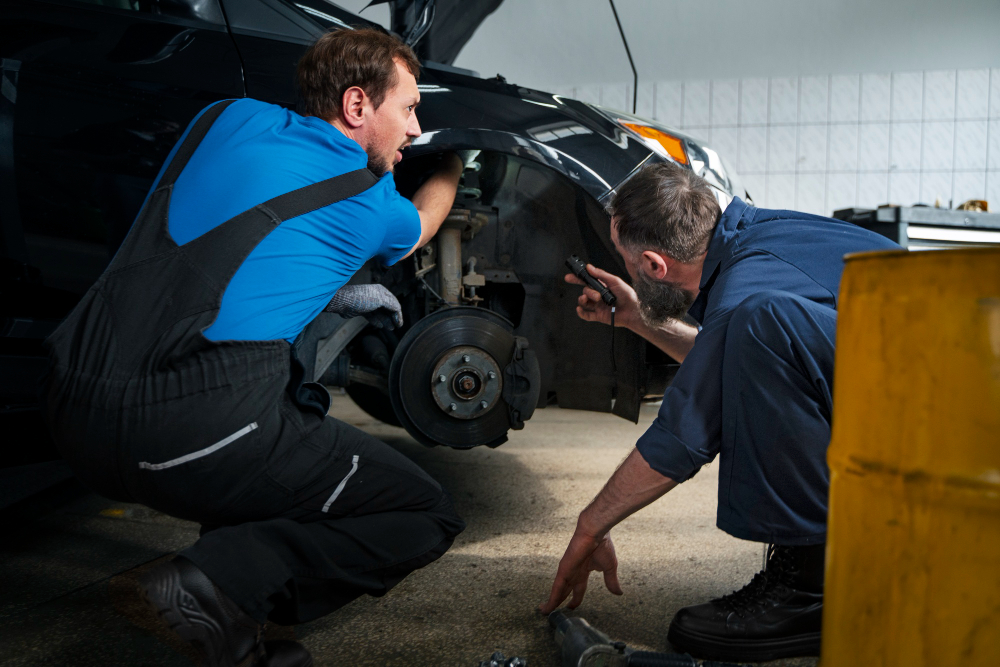
If you bring in a car making grinding noise when braking, here is what a proper inspection actually involves, so you know what to expect.
- A visual check of pad thickness on all four wheels, since front and rear pads often wear at different rates
- An inspection of the rotor surface for scoring, grooves, or uneven wear
- A check of the caliper, making sure it moves freely and is applying even pressure
- A test drive when needed, to confirm whether the sound is coming from the brakes specifically or somewhere else, like a wheel bearing
A shop that skips straight to “you need new pads” without actually checking rotor condition is guessing, not diagnosing. That distinction matters, because if your rotors are damaged, new pads alone will not fully fix the noise or the safety issue.
What Repair Usually Involves
In most straightforward cases, fixing a car making grinding noise when braking means replacing the worn brake pads and, if the rotors have been damaged by the metal to metal contact, resurfacing or replacing the rotors as well.
- Pad replacement alone is possible if you caught the problem early and the rotors are still in acceptable condition
- Pad and rotor replacement together is common once grinding has occurred for any length of time, since the damage to the rotor surface is usually part of the same event that caused the noise
- Caliper service or replacement is needed in less common cases where a stuck caliper is the actual root cause
A trustworthy shop will show you the actual condition of your pads and rotors, not just tell you what to replace. If you can see the wear yourself, you are in a better position to trust the recommendation.
How to Prevent This From Happening Again
Once your brakes are repaired, a few simple habits help you catch the next warning sign before a car making grinding noise when braking happens again.
- Pay attention to any squealing sound, that is your brake pads’ built in warning system doing its job
- Get your brakes inspected at least once a year, more often if you do a lot of stop and go city driving
- Avoid ignoring a soft or spongy brake pedal, which can indicate a separate but related issue
- Ask your shop to check pad thickness during any routine maintenance visit, even if you are not there specifically for brakes
Catching this early is the entire difference between a routine pad swap and a car making grinding noise when braking that could have been avoided.
Get Your Brakes Checked Today
If your car making grinding noise when braking is what brought you here, do not wait for it to get worse. Our team has handled brake diagnosis and repair for Baltimore drivers for over 10 years, and we will tell you honestly what your vehicle needs, not just what sounds like the easiest sale.
Call 410-889-6536, email rolandfallsauto@gmail.com, or visit us at 1100 W 41st St, Baltimore, MD 21211 to get your brakes checked. Learn more about our full range of services at rolandfalls.com.